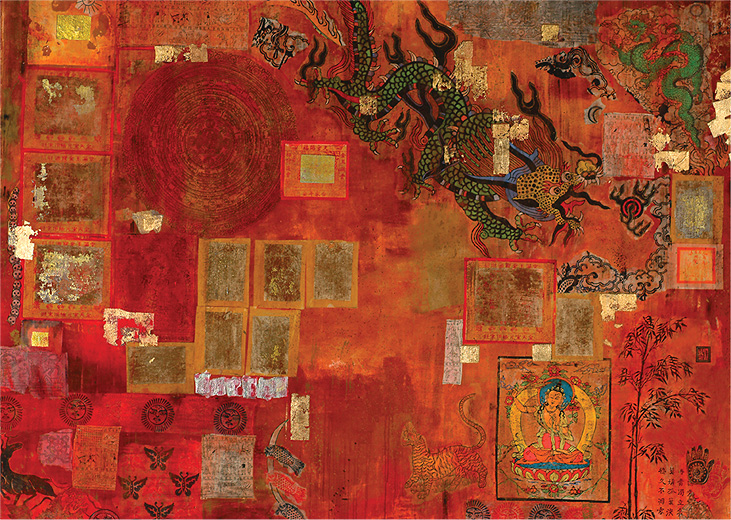
LU (THE WANDERER)
A chronicle of the artist’s Eastern wanderings, possibly inspired by a hidden hermitage lost in the shadowy feet of the Himalayas, ‘Lu’ is an eclectic anthology of Chinese, Indian and Tibetan images in antique reds and faded gradients of yellow ochre. Cryptically deployed metaphors of Eastern mythology curiously combine with squares of gold - the same shimmering gold leaf applied by pilgrims on devotional icons throughout Asia - arranged within an ordered sequence across a mysterious surface.
An exotic recontextualization of autobiographic imagery that has lain dormant for many years is strikingly captured within its own visual language. Perhaps the fragment of an ancient wall or an imagined labyrinth? The overall effect gives one the eerie feeling of something undeniably deliberate, suggestive of ancient intelligence, a primary code, a riddle, a Zen koan, or a post card from the void? It appears to be a maze of symbols ordered by some uncanny cryptic logic, knowledge passed down through the epochs to secret priesthoods, initiating carefully guarded messages and magical truths. Within the ephemeral memorabilia is the story of violent deaths, heroes, dancing Dakinis, plunging dragons, roaring tigers, leaping fish, and butterflies that can fly a thousand miles. Birds form a migratory flock and sun gods reign beside the hand of Fatima.
Alien to the mind, but deeply familiar to the soul, it conjures a strangely musical pattern revealing a world of opium dens, Oriental antique shops or the wet walls of a distant Chinatown back alley. The almost tangible ambience of the piece alludes to a personal journey of social and spiritual growth that reflects not only Asian travels, but also an intuitive ability to tap into the unconscious mind. Characterised among the miscellany of ancient symbols, secret messages and hazy encounters is the I Ching Hexagram ‘Lu’, The Wanderer, which gives its name to the piece.“Strange lands and separation are The Wanderer’s lot. He does not lose touch with his inner being” (I Ching Book of Changes)
“In my works can be found the residue of actual experiences - captured impressions that could not be let go of. The real action is in getting it out; a bit like trying to jot down a message quickly before you forget what you’re trying to say, or an attempt at remembering a dream before it slips away.”
|