| |
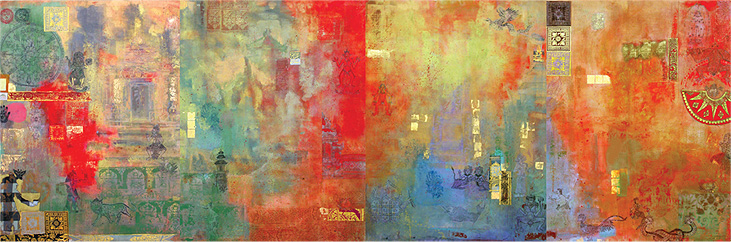 Sekala & Niskala 440cm X 145 Acrylic and mixed media on canvas Bali 2003
 |
Part of the ‘Alchemy of Asia’ series; the ‘Sekala & Niskala’ are four paintings in acrylic, incorporating mixed media and collage elements. The works represent and explore ‘the seen and unseen’ forces on the island of Bali, a phenomenon explained by Fred B Eiseman Jr., in his books ‘Bali Sekala & Niskala, as the “tangibles and the intangibles in the realm of Balinese religion, ritual and performing arts. What we see is known as Sekala, a fertile tropical island and a colourful world of ceremony, ritual, dance and drama. What we don’t see is the Niskala – the occult – the powerful subterranean forces that have shaped the island’s existence, and the intricate web of social organizations that have caused its civilisation to fl ourish – the doctrine underlying the pageants, the code underlying the rites and the magic underlying the dance.”
Much more than just landscapes, draped in the hush between the apparent and the ambiguous, the series could perhaps be described as a roadmap and guide to the spiritual world of Bali. The artist has drawn on the experience of his twenty years of life in Bali, his respect for the Balinese Hindu religion, his recognition of parallel forces, his mystical encounters, and the evolution of consciousness that has brought him to this stage. The pieces are the manifestation of that evolution, images gained from years of attending ceremonies and ‘Wayang Kulit’ shadow puppet shows. His position as observer has kept his feelings on a purely objective plane and this open-mindedness has somehow attuned him to the invisible forces. Playing with the elusive merits of the transient, the hidden and the enigmatic, his depiction of the spirit world displays his personal sensitivity and perception. In order to capture the essence of the supernatural forces at work within Bali, he has utilised Balinese objects and cloth, together with reproductions of Balinese talisman, in his representations. None of the magic symbols were randomly chosen; instead each was selected after consultation with a Balinese priest to ensure harmony with the cosmic order.
The artist is not transcending from the physical world into the spiritual, but instead, through the use of traditional colours, ornamentation, motifs and symbolism, he is depicting how the Balinese live in a state of co-existence with the both worlds, thus maintaining a balance between opposing forces. In the paintings we are introduced to the gods, the messengers, the protectors, the actors and the amulets, the talismen and the funny men, the mandala, the gobetweens and the in-betweens; the representations of that which cannot be sensed directly but can only be felt within. The paintings reveal how these agents of power combine to create the mythic elixir of life.
As temples dissolve into mist, the portals open to give the viewer a glimpse of some of the key players. The first painting depicts a temple partially obscured by a gold swirling mist. Nawa Senjata, the nine weapons of the nine gods of the nine directions are depicted as a compass. The directional symbolism emphasises the importance of spatial and spiritual orientation. Within each of directions indicated by the cardinal points and their intercardinal divisions dwells a separately named aspect of God. The black and white chequered cloth, known as Poleng, embraces the Balinese-Hindu principal that for every positive force there is a counterbalancing negative force; two inseparable sides that must necessarily co-exist, preferably in dynamic equilibrium. A nameless creature with the body of a tiger paces across the canvas, his portrayal symbolises a request for a successful rice harvest, while Sari Ning Empu Bahula, sitting on the steps of the shadowy temple, protects believers from attack by ‘Leyak’ or spooks.
|
|
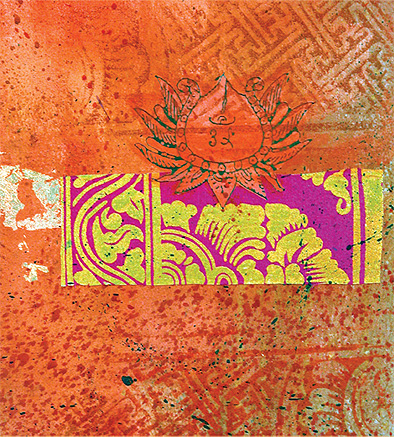 Detail Panel 2
 |
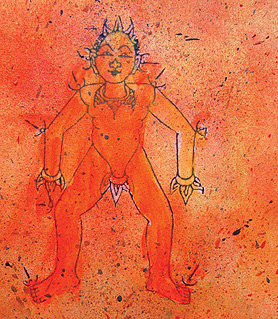 Detail Panel 3
 |
The second panel in its subtlety evokes a complex of emples on a mountainside. Red and amber merges with gold and the moody green of a dark forest. Random splashes could be representational of rain on the mountain, the presence of Bali’s most sacred and revered volcano is felt but not seen. Clearly visible, however, is a detail of Balinese temple architecture with its symmetrical patterns and relief, Bali rococo, brick and stone veneer, decorative facia, elaborately carved ornamentation and a diminishing multi-tiered pagoda-style roof or ‘meru’. The comical joker from the wayang kulit show entertains the viewers as he makes merry in the corner and a pair of indiscernible enigmatic figures mysteriously vaporize into oblivion.
The imagery on the third canvas echoes the mood of the preceding pieces with the introduction of amethyst hues. Could it be a stairway to heaven rising out of a purple haze? The mauve mist is interposed with an abundance of gold, which then gently fades to warm cadmium orange. The ever prevalent temple gates, steps and meru are only just visible, the remainder we must imagine. Through a conduit between the two worlds a dragonesque beast flies across the sky on an arrow, guiding us onto an elevated spiritual level, his name is Naga Pasa. He is joined by the eccentric image of Penulak Sarva Mrana, the protector of the rice. Twins with the linked arms and the bodies of tigers combine to form a talisman that will prevent the bearer from feeling scared.This passage from the patent to the nascent, from the earthly to the elusive, epitomizes the spiritual ambience of Bali.
The final piece is a plethora of tangerine tones, oranges and flame red. In the centre there is a glimpse of yellow nature – flowers, petals and leaves, components of the Balinese offerings to their gods. The intrinsic focus is exemplified by the chicken and snake-like creatures that sustain the perimeters. Splashes of gold merge into a nucleus of smoky incense dappled with forest green. Once again spirit guardians guide us around the canvas. A quirky upside-down custodian known as Kala Sungsang is suspended in limbo.
|
|
|
 Sekala & Niskala Panel 3 110cm X 145 cm
 |
After the ceremonial requirements, his duty is to hang above the door of an abode to protect the home and its inhabitants from robbery and danger. More spirits emerge from the fog of confusion, as revelation takes place. The artist has led the viewer through the first stage of a journey, an introduction perhaps and, without doubt, a personal homage to the Island of the Gods. |
|
|
|
|


